overleaf template galleryLaTeX templates and examples — Recent
Discover LaTeX templates and examples to help with everything from writing a journal article to using a specific LaTeX package.
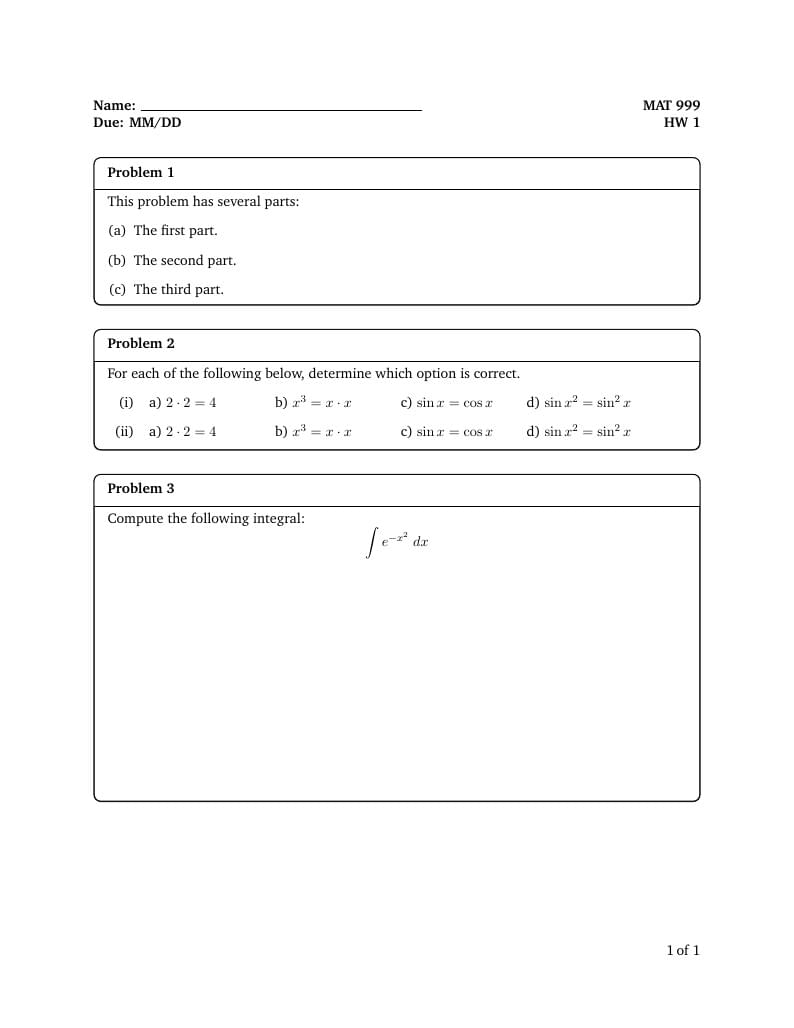
Welcome to Joyner Document Format (JDF) v2.2! JDFis primarily intended to standardize page lengths while ensuring readability. Note that you are required to use JDF for all written assignments, but we will not perform explicit formatting checks.So, while improper formatting may be subject to penalties, you should not worry too much about whether your submission con-forms to every minute detail; the most important elements are margins, font, font sizes, and line spacing. Just make a copy of one of the provided templates and replace its contents with your own, using the built-in paragraph styles. If you do so, you do not need to verify that the style was followed

https://github.com/mohuangrui/latexspine LaTeX Template for Producing Book Spine

This article (17 pages) was written to accompany an Overleaf help item. It explores the meaning of underfull or overfull boxes and examines the calculation of badness using an \hbox with finite and infinite glues. We have tried to provide a range of examples to demonstrate various aspects of TeX engines’ box-construction behaviour and the underfull or overfull “diagnostic messages” issued by TeX engines during the box-creation process.

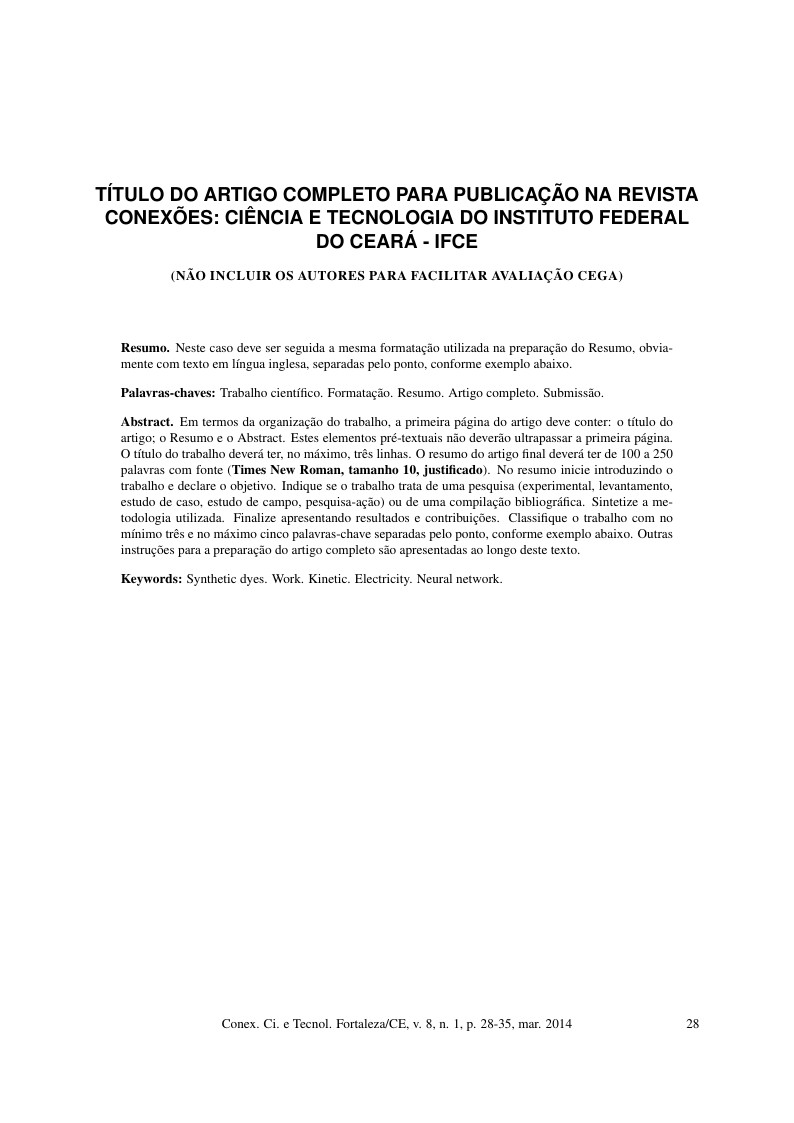
Modelo não oficial criado para apresentação de TCC para o Instituto Federal de Educação, Ciência e Tecnologia do Ceará - IFCE

Journal template for Medical Physics based on RevTeX. A few non-obvious settings had to be done in the manuscript file. This template was generated from the manuscript file (Elze and Tanner, 2009) This template was downloaded from http://www.tobias-elze.de/latex/ on 19 November 2015.

University of Bristol (Master's Thesis) Template for the school of engineering

Formato para la elaboración de los reportes del laboratorio de electrónica L-23

This is PIM individual assignment template

Based on the paper Sometimes Newton's Method Cycles, we first asked ourselves if there were any Newtonian Method Cycle functions which have non-trivial guesses. We encountered a way to create functions that cycle between a set number of points with any initial, non-trivial guesses when Newton's Method is applied. We exercised these possibilities through the methods of 2-cycles, 3-cycles and 4-cycles. We then generalized these cycles into k-cycles. After generalizing Newton's Method, we found the conditions that skew the cycles into a spiral pattern which will either converge, diverge or become a near-cycle. Once we obtained all this information, we explored additional questions that rose up from our initial exploration of Newton's Method.
\begin
Discover why over 25 million people worldwide trust Overleaf with their work.